Gemma Tiberiana
Graphic and documentary material | 1622
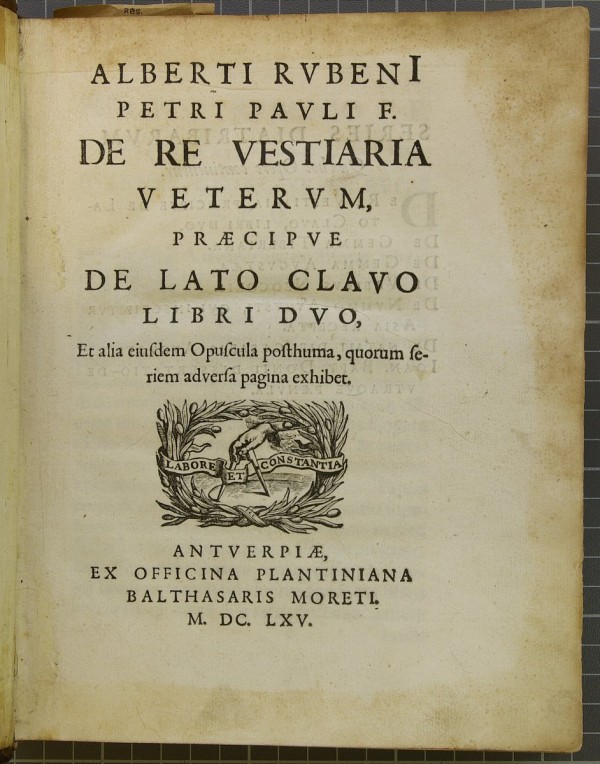
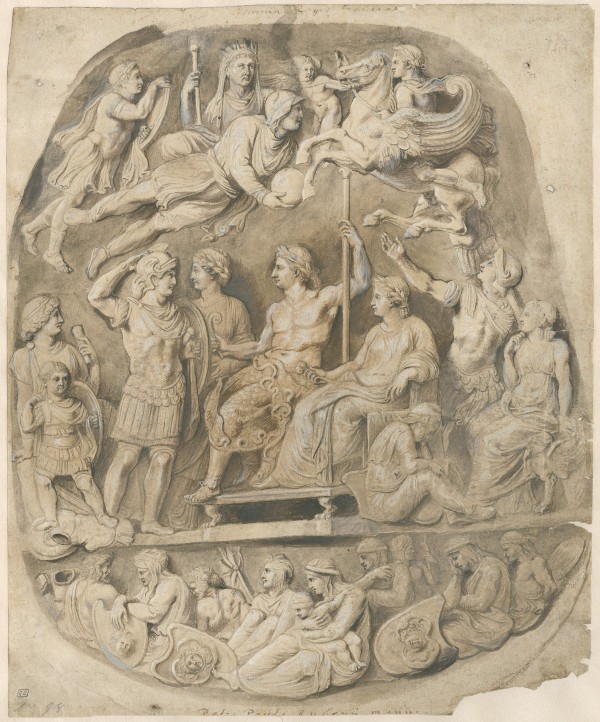
This drawing is recognized as a Flemish masterpiece. It depicts the famous Gemma Tiberiana, the largest cameo - a stone carved in relief - preserved from antiquity. The stone was discovered in Rubens's time in the Sainte Chapelle in Paris and was identified by Claude-Nicolas Fabri de Pereisc. Around 1622, Rubens made this drawing at the request of Pereisc, who was preparing a publication on cameos from antiquity. In 1623, the drawing was put into print, but the planned publication never saw the light of day. It was only in 1665 that the drawing was finally used, then as an illustration in De Re Vestiaria Veterum, a publication by Rubens's son, Albert, edited by Balthasar Moretus.
The drawing is a relatively faithful life-size reproduction of the cameo. We do not know with certainty the exact subject of the cameo. According to Pereisc, the scene at the top represents the deification of the Roman emperor Augustus, the middle register shows Germanicus in front of Tiberius and Livia, and the lower section depicts the conquered peoples. Recent research has questioned the attribution to Rubens and suggested that it may have been composed by a collaborator and merely 'retouched' by Rubens in brown ink and white opaque paint.
Today, the stone is kept in the Bibliothèque Nationale of France.
The makers
In the good hands of
Museum Plantin-Moretus
