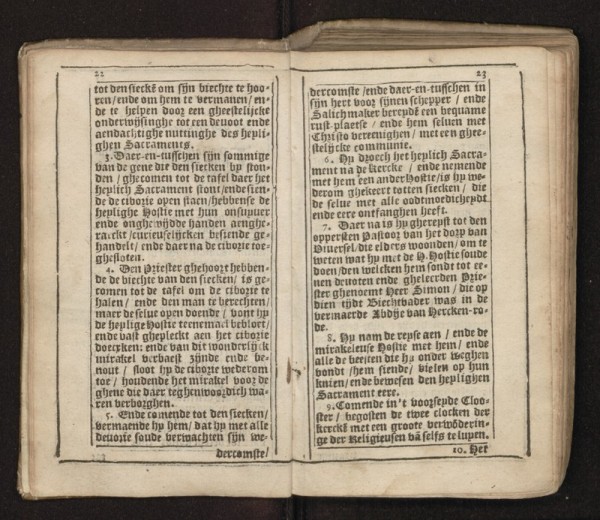
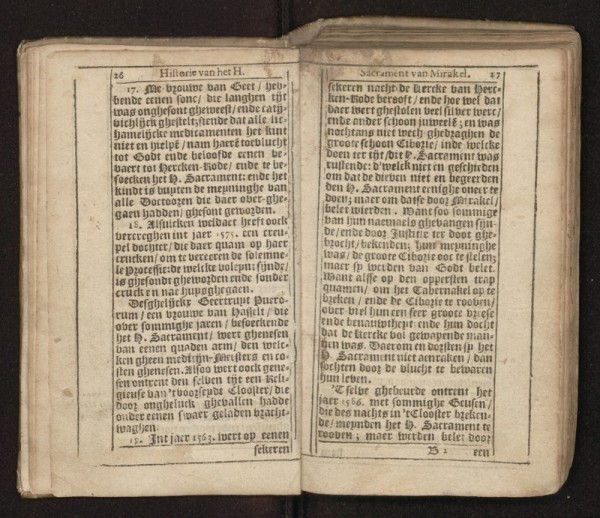
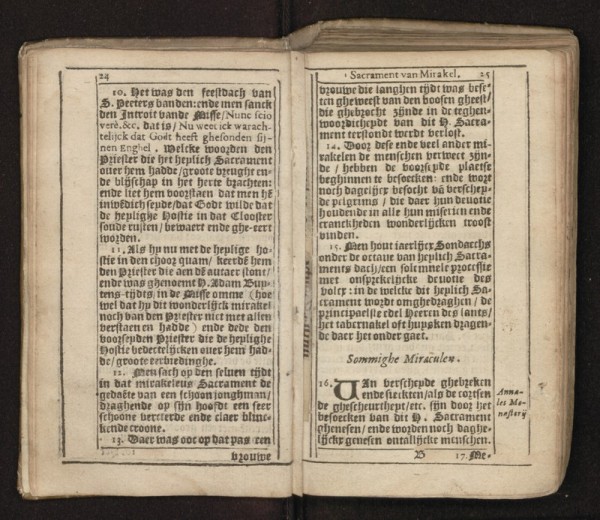
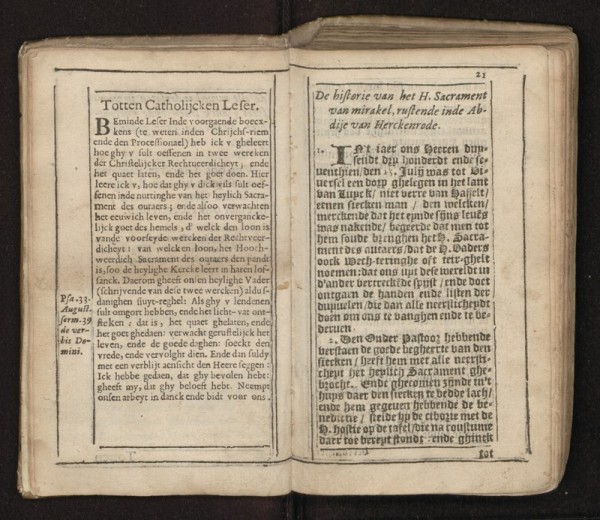
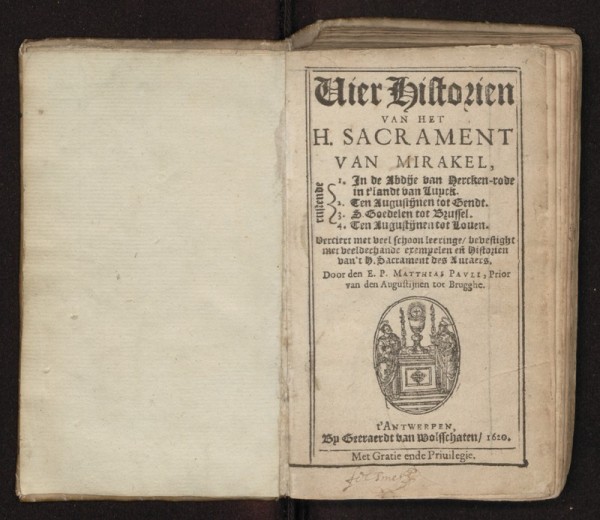
Vier historien van het H. sacrament van mirakel, rustende 1. in de abdije van Hercken-rode in t'landt van Luyck. 2. Ten augustijnen tot Gendt. 3. S. Goedelen tot Brussel. 4. Ten augustijnen tot Louen
Early modern edition | 1620 - | Antwerp | Dutch
The abbey of Herkenrode, the Augustinian churches of Ghent and Leuven and the Cathedral of Brussels all possessed miraculous hosts (Communion wafers) which bled when unconsecrated hands touched them. In 1620, Mathias Pauli (1580-1651), an Augustinian monk from Hasselt, published the story of these hosts and their miracles in a book that he dedicated to the abbess of Herkenrode, where the oldest of the four miracle stories took place. These stories of miraculous bleeding are related to the sacrament of the Eucharist, which Jesus Christ himself instituted at the Last Supper. In 1215, the Fourth Lateran Council defined how the transformation of bread and wine into the flesh and blood of Christ should be understood. The veneration for the Blessed Sacrament of the Altar, as it was called, reached a high point in the Diocese of Liège, where the Feast of the Blessed Sacrament was instituted as early as 1246, before being adopted by the entire Catholic Church 18 years later.
From:Collection title
In the good hands of
Bibliotheek Hasselt Limburg, OD-D-0485
Printer's mark
More about Collection title
Collection description
