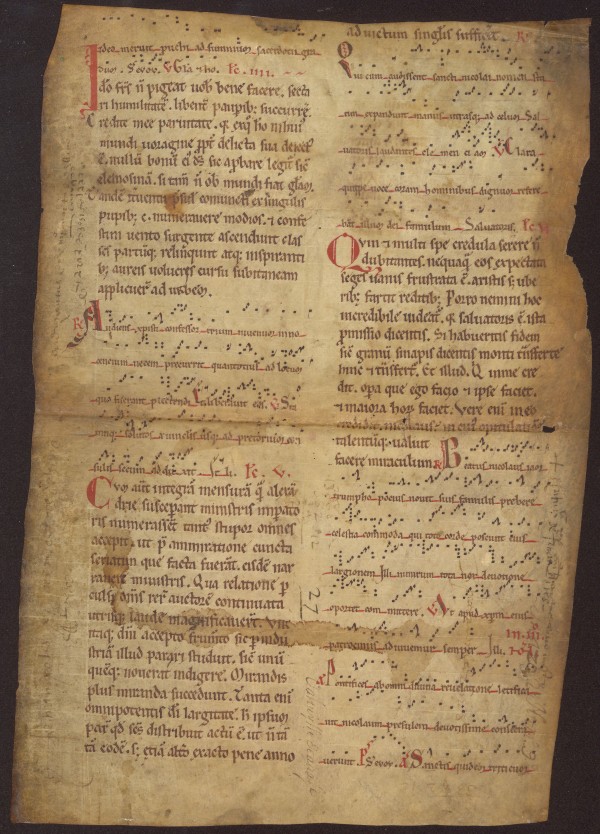
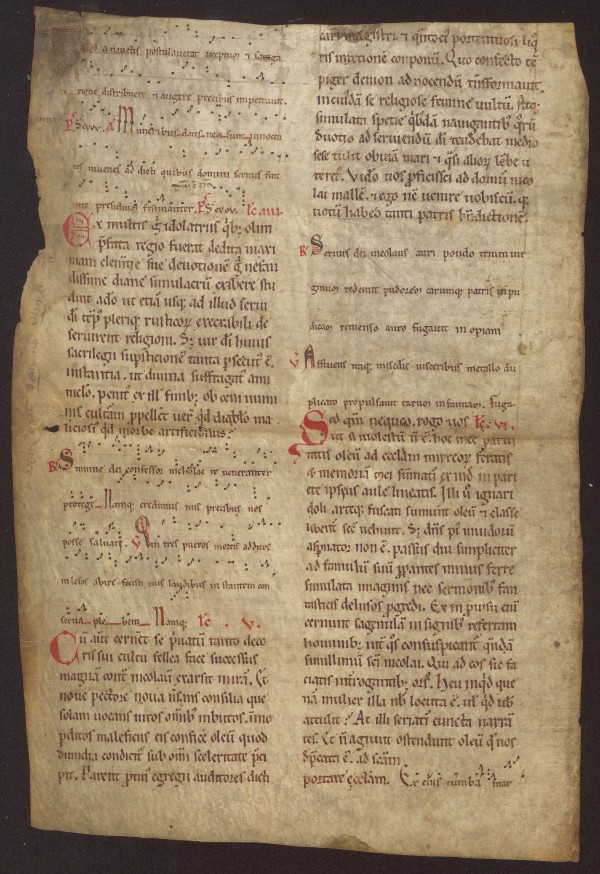
Gregorian fragment
Explore the workGregorian fragment
ca. 1050
These manuscript fragments bear witness to historical musical notation and Gregorian chant.
There are many ways to write music. Best known is the notation that uses a number of horizontal lines – called staves – on which you write notes at different pitches. The shape of the notes indicates their length. This establishes two important parameters: pitch and rhythm.
However, this score dates from a time when the stave was not yet in use. The notes were written “in campo aperto” or 'in the open field'. The notion of pitch is clearly present, but the duration of the notes remains a matter of guesswork. This fragment dates from around 1050. In a later period, this parchment sheet was “recycled” as a book binding. The binding holes in the middle indicate a sloppy binding. A number of handwritten remarks have also been added on the other side. All in all, it shows little respect for Gregorian chant and historical musical notation, but as a result, the sheet has been preserved. Otherwise, it might have disappeared "in mundo aperto".
In the good hands of
Koninklijk Conservatorium Brussel
