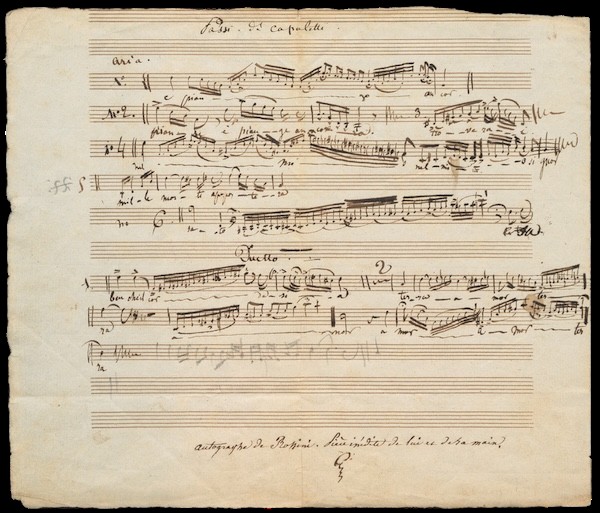
Passi di Capuletti
Explore the workPassi di Capuletti
Manuscript | 1833 | Paris | Italian
The Passi di Capuletti are a crucial historical source for the performance of Bellini's opera and the bel canto tradition. In the bel canto tradition, the composer determines almost entirely what will be heard, except at the end of an aria. That is the domain of the singer. He or she is given the freedom to embellish the final passage - the cadenza - according to their own artistry and ability. This page with “passi di Capuletti” fits into this tradition and contains written cadenzas for solo arias and duets. At the bottom it is stated that this is Rossini's handwriting. It may display the fluidity and sloppiness of Rossini's handwriting, but today there are doubts about its attribution to the Italian maestro. Nevertheless, it remains an extremely fascinating document. Firstly, due to its link to “I Capuletti e I Montecchi”, one of the most successful operas by Vincenzo Bellini (1801-1835). This work premiered in Venice and conquered both Europe and the New World from Italy. This sheet with the cadenzas is probably linked to the Paris performance at the “Théâtre Italien” in 1833. At that time, Rossini was active in Paris as an artistic advisor. The roles of Romeo and Giulietta were performed by the mezzo Giuditta and the soprano Giulia Grisi. The embellishments were therefore probably intended for the Grisi sisters and likely developed in consultation with the artistic advisor. The document also remains important as a testimony to bel canto cadenzas of the time. As there are no recordings from that period, this sheet with ‘passi’ is particularly relevant to the historical performance practice of bel canto.
The makers
In the good hands of
Koninklijk Conservatorium Brussel
